Is the AI arms race turning innovative software giants into infrastructure companies?
Microsoft’s capital spending went from $28.1bn to $115.9bn in three years, up more than 300%. Its research budget went from $27.2bn to $35.6bn, up 31%. Alphabet’s capex grew 74% last year to $91.4bn, while its research spending rose 24% to $61.1bn. The companies that spent two decades competing on what they could invent now compete on power and space.
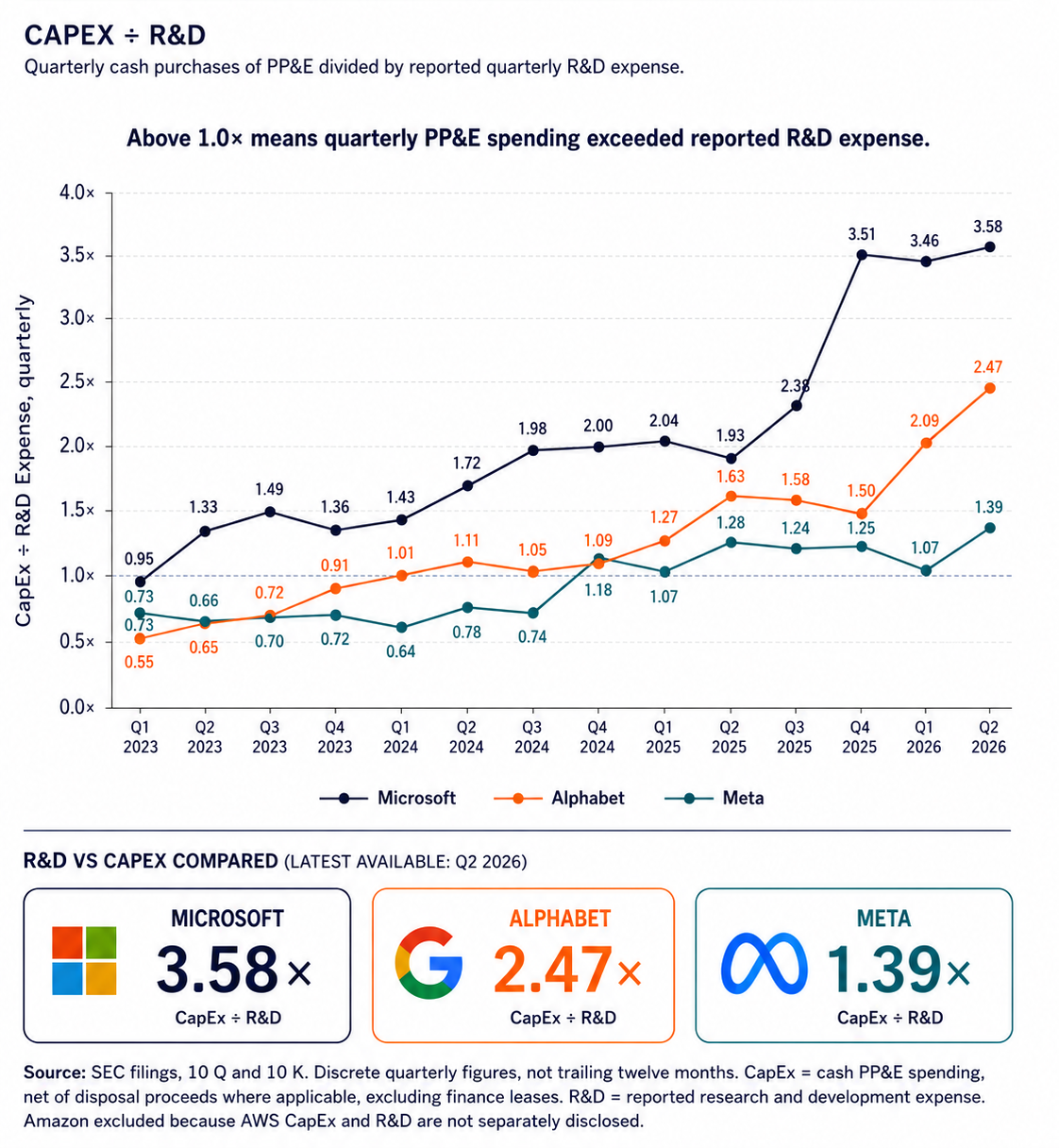
That changes the problem. The software company and the infrastructure company are becoming the same company, and they now sign obligations that can outlive several generations of the technology those obligations were meant to support.
Behind one data centre campus, a utility may recover its plant over thirty years, a developer may hold the building on a fifteen or twenty year lease, and the hyperscaler may write down the silicon inside it over five or six. The hyperscaler has signed against all three clocks and carries all three at once.
Yet inside the company, those terms are often set across go to market, finance, legal, procurement and infrastructure teams, and each function can make a rational decision on its own. The problem appears when nobody lays the commitments end to end and asks what the whole thing owes, when it owes it, and for how long. That is a commercial strategy problem before it is a finance one, and the governance has to sit in the gap between those clocks.
The physical build makes the mismatch harder. Data centres have been in the news for years, and if you turn on CNBC almost every gigawatt planned by the Mag 7 gets announced, and the market moves on the information. But an announced project is not a built project.
A simplified development path looks something like this:
Announced → Land control → Permitted → Power secured → Financed → Under construction → Earning revenue
The market keeps close score of the announcement, but the harder work comes later. Grid access is the clearest example, and the numbers describe the supply side, not the data centres themselves. Berkeley Lab tracked generation and storage projects seeking transmission interconnection: only 13% of the capacity that entered those queues between 2000 and 2020 had reached commercial operation by the end of 2025, and the median project completed in 2025 took more than five years from request to operation. That is the supply the new demand is counting on, and it clears far more slowly than the buildings that need it.
Texas shows what happens when demand runs into that clock. ERCOT runs almost the entire Texas grid, and by mid 2026 it was carrying roughly 474 gigawatts of large load interconnection requests, more than five times the state’s record peak demand, with around nine in ten of them tied to data centres.
Then the rules changed. On 3 August, Texas governor Greg Abbott froze the queue and ordered an audit covering roughly 250 to 300 projects. You can plan around a long lead time. It is much harder to plan around a new gate that appears after the project has been announced.
Equipment creates another constraint. A large power transformer can still take around two and a half years from order to delivery. I have seen this first hand: tariffs moved, prices moved with them, and supply chains that looked dependable suddenly did not.
Even if a project clears every physical gate, another clock is moving inside the building: the useful life of the technology. For decades the industry could plan around a relatively predictable cycle of improving compute economics. AI has compressed that cycle while increasing the capital committed against it.
The accounting reflects the uncertainty. Meta extended the estimated useful life of most of its servers and network equipment to five and a half years from the start of 2025. Amazon moved the other way for some servers and networking equipment, reducing their estimated life from six years to five as it responded to faster development in AI and machine learning. Neither decision proves what the useful life of AI infrastructure actually is, and that is the point. Asset life depends on workload, architecture, refresh strategy and what comes next.
But the building, the power infrastructure and the contractual commitments around that equipment can run for fifteen, twenty or thirty years. The silicon can change several times while the obligations around it remain.
Power creates another mismatch, because the economic consequence does not necessarily stay with the company creating the demand. PJM, the largest power market in the United States, serves about sixty five million people across thirteen states. Its capacity price jumped from roughly $29 to $270 per megawatt day in a single auction, as the system faced tighter supply and rapidly growing demand, including from data centres. Who caused exactly how much of that increase will be debated, but the commercial point is simpler: the people absorbing part of the cost never signed the data centre contract.
And most companies are not hyperscalers, utilities or data centre developers. They rent a room in somebody else’s building, the white space, and what they carry is narrower: the lease, the common area costs, the hardware and the electricity. The hardware may turn over several times during the life of the lease. The building cannot, and the power cost can change while both remain in place.
The companies that avoided the building problem by moving to the cloud did not escape the infrastructure problem either. Their capacity now sits on somebody else’s queue and somebody else’s turbine, and they simply do not see either one.
This is why the commercial architecture matters. Make what gets signed and what gets announced say the same thing. Govern the portfolio to the power date, not only the construction date. Read the utility commitment, the property term, the equipment life and the customer obligation as one economic position rather than four separate contracts. The terms only line up if somebody on the buying side reads across the whole chain and has the standing to say when they do not.
This is one of the least glamorous parts of building an AI infrastructure portfolio, which may be exactly why it gets less attention than the announcement. The companies that used to sell software are now signing obligations that can run for decades. The ones that come out of this well will be the ones that knew exactly which part they were holding, and for how long, before they announced it.